Pricing verified 5 Oct 2026
LaunchDarkly Pricing 2026: What Teams Actually Pay
A desk analysis of the live pricing page, the billing documentation and four review platforms, with three modelled bills and the limits of each plan.
Summary
LaunchDarkly pricing in 2026 has three tiers: a free Developer plan, a pay-as-you-go Foundation plan billed per service connection and per 1,000 client-side MAU, and custom Enterprise contracts. On published rates, a 40-service platform with 250k MAU lands near $38,790 a year on annual billing, and monthly billing adds 20%. Audit logging, approvals and automatic rollback (the paid Guardian add-on) are not part of Foundation. We priced it from public data and did not buy a plan.
LaunchDarkly pricing is fair for what the product does and hard to forecast. Foundation bills $10 per service connection and $8.33 per 1,000 client-side MAU each month on annual terms. We modelled a 40-service, 250k-MAU platform at $38,790 a year. Flag depth is excellent, but audit logs, approvals and automatic rollback sit behind Enterprise or the paid Guardian add-on.
- Flag capability
- 9/10
- SDK coverage and latency
- 8.5/10
- Pricing predictability
- 5/10
- Release safety automation
- 6.5/10
- Governance on self-serve
- 6/10
- Support on self-serve
- 6/10
- Unlimited flags and seats on every plan, with 30 SDKs across client, server and edge
- Config delivery latency SLO of under 200 ms on Foundation and under 150 ms on Enterprise
- G2 rating of 4.5/5 across 867 reviews, with ease of use the top praised theme
- Two usage meters (service connections and client MAU) make the annual bill hard to predict
- Audit logging, approvals, custom roles and SCIM are Enterprise only, not in Foundation
- Kubernetes, serverless, Python and Ruby workloads are quoted custom, so list price may not apply
Free Developer plan, no credit card
How we priced it
- Plan paid
- No paid plan purchased: public pricing page, Developer plan terms and billing documentation
- Version tested
- LaunchDarkly pricing page and docs as live on 5 Oct 2026 (CodeControl and AgentControl packaging)
- Test period
- 2026-10-05 → 2026-10-05
This is not a 30-day hands-on test, and we do not pretend it is. On 5 October 2026 we captured the live LaunchDarkly pricing page, read the full plan comparison table and the 'Calculating billing' documentation, and collected ratings and written pros and cons from G2, Capterra, TrustRadius and Trustpilot, plus two public Reddit threads about cost. We then modelled three bills with the published unit prices.
Where the vendor's own pages disagree, we say so. Our arithmetic is labelled as such. Screenshots are unedited captures of the vendor's pages taken the same day.
Should you pay for it?
YES if you...
- Platform teams of 50 to 500 engineers who need audited flags, approvals and SSO across many services
- Teams with a few long-lived server-side services and a modest client MAU count
- Product teams where non-engineers toggle flags and need an interface they can learn in a day
NO if you...
- Teams running mostly serverless, Kubernetes, Python or Ruby workloads that need a published list price
- Consumer apps with large, spiky client MAU counts and thin margins
- Startups that need audit logs or approval workflows without an Enterprise contract
- Teams that want per-seat predictability or open-source self-hosting
LaunchDarkly plans, October 2026
Foundation prices shown on annual billing. Monthly billing is $12 per service connection and $10 per 1,000 client MAU.
Developer
Free to start, no credit card
- Unlimited seats and unlimited feature flags
- 1 project and 3 environments
- 5 service connections and 1K client-side MAU
- 5K session replays, 5K errors, 10M logs and traces
- 100K experimentation MAU
- Config delivery latency SLO under 300 ms
Foundation
Pay as you go after a 14-day trial, plus $8.33 per 1K client-side MAU
- Unlimited projects and environments
- First 5 service connections included
- 5K AI runs included, then $5 per 1K runs
- Config delivery latency SLO under 200 ms
- Community support (Discord), Bronze level
Enterprise
Contracted volumes and an SLA
- Audit logging, custom roles and teams, SCIM
- Workflows, scheduling and approvals
- Advanced targeting and release automation
- Latency under 150 ms (SLA)
- Guardian add-on (automatic rollback) priced separately
ROI breakdown: At 115 paid connections and 250k client MAU, Foundation costs about $3,233 a month on annual terms. The same workload is $3,880 a month on monthly billing, a 20% premium for flexibility.
Hidden costs & gotchas
- Monthly billing costs 20% more than annual on both meters ($12 vs $10 per connection)
- Kubernetes, serverless, Python and Ruby workloads are quoted custom, not at list price
- Automatic pause or rollback needs the Guardian add-on, priced separately on top of Enterprise
- The pricing page lists SSO and SAML on every plan, but the comparison table shows them for Enterprise only
- Developer plan converts to read-only mode if usage keeps exceeding its entitlements
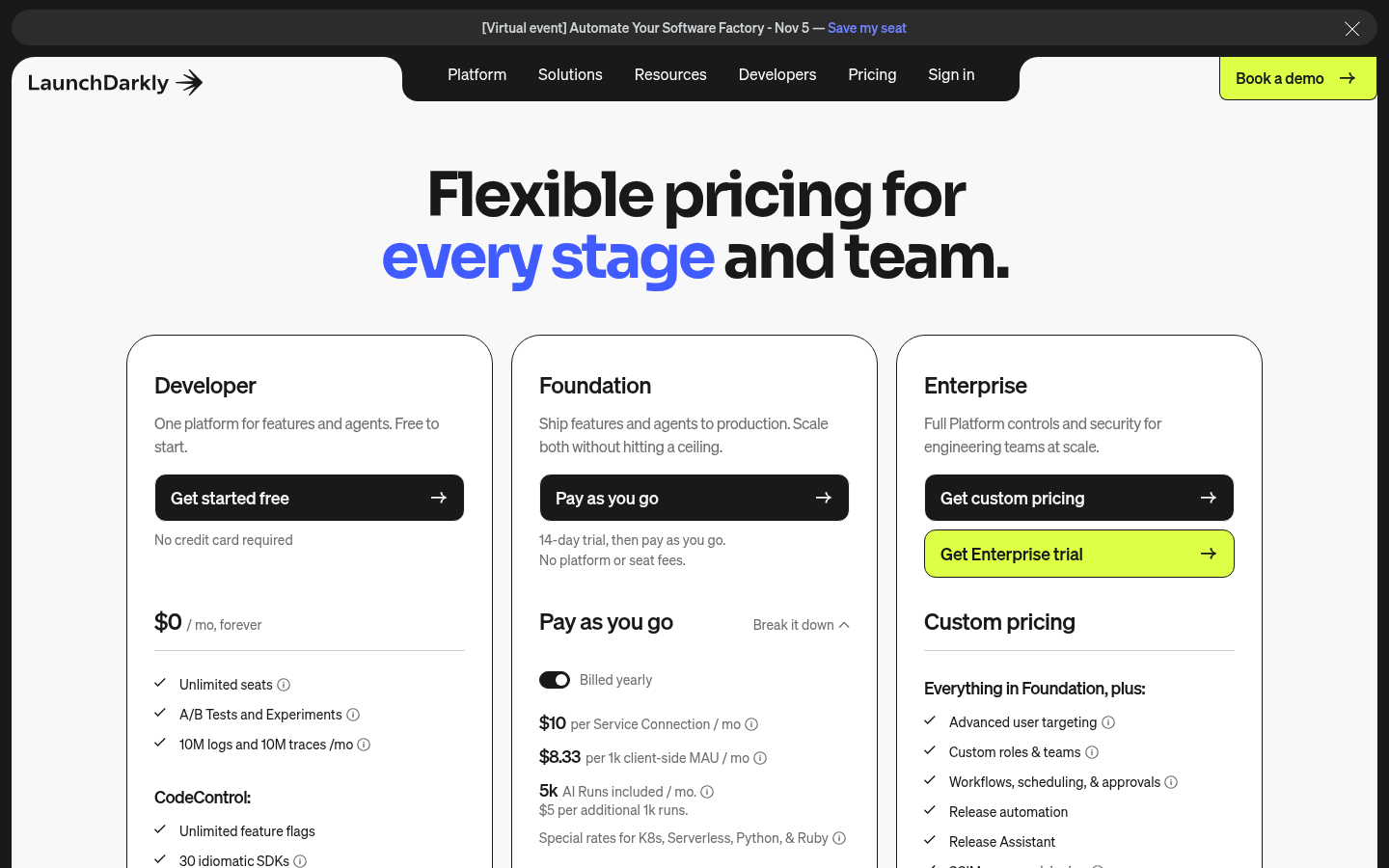
The pricing page, 5 October 2026
This is the live Foundation card with the yearly toggle on: $10 per service connection and $8.33 per 1,000 client-side MAU. The 'Break it down' control and the note on special rates for Kubernetes, serverless, Python and Ruby are on the same card.
- Billed yearly toggle changes both meters
- 5K AI runs included, $5 per additional 1K runs
- No platform or seat fees on Foundation
The numbers behind the review
Published prices and review data captured on 5 October 2026, plus three bills computed from them.
- Service connection price
- $10 per connection per month Annual billing; $12 on monthly billing (pricing comparison table and G2 listing)
- Client-side MAU price
- $8.33 per 1,000 MAU per month Annual billing; $10 on monthly billing per the comparison table
- Modelled bill, 40 services x 3 environments, 250k MAU
- $38,790 per year 115 paid connections x $10 + 250 x $8.33, times 12. Our arithmetic, annual billing
- Monthly billing premium
- 20% $46,560 a year monthly vs $38,790 annual for the same workload
- Config delivery latency SLO
- 300 / 200 / 150 ms (Developer / Foundation / Enterprise) Pricing page comparison table; the Enterprise figure is an SLA
- G2 rating
- 4.5 out of 5, 867 reviews 69% five-star, 28% four-star, 1% three-star
- Capterra rating
- 4.7 out of 5, 26 reviews 5 of the 26 reviews name price or pricing model as a con
- TrustRadius score
- 8.6 out of 10, 60 reviews 2 of the 10 reviews on the first page cite cost
Early-stage SaaS: 8 services in 2 environments (16 connections) and 20,000 client-side MAU. Foundation cost on annual billing?
Mid-size platform: 40 services in 3 environments (120 connections) and 250,000 client-side MAU. Annual versus monthly billing?
AgentControl: 20,000 LLM requests a month, online evals on every request versus a 10% sample. Cost beyond the 5K included AI runs?
Pros and cons of the pricing model
Pros
- Unlimited seats and unlimited flags on every plan You pay for connections and client MAU, so inviting the whole team costs nothing.
- Free Developer plan is a real evaluation environment 5 service connections, 1K client MAU and 100K experimentation MAU are enough to wire up a staging pipeline.
- Documented billing rules and overage emails The billing docs explain how MAU and connections are counted and say the account owner gets email alerts as overage grows. LaunchDarkly says it never stops or throttles service when you exceed a MAU limit.
- Latency is a stated SLO, not a vibe Under 300 ms, 200 ms and 150 ms by tier, a number an SRE can put in a design review.
Cons
- Two meters that scale with different things Connections grow with services and environments, MAU with customers. A launch moves both.
- Governance features are locked to Enterprise Audit logging, custom roles, SCIM, workflows and approvals are not in Foundation.
- Automatic rollback is a separate paid add-on Release monitoring, guardrail metrics and automatic pause or rollback are listed under Guardian, priced separately on top of Enterprise.
- Custom quotes for the stacks most platform teams run Kubernetes, serverless, Python and Ruby get tailored packages because they create many server-side connections.
The billing documentation explains the meters
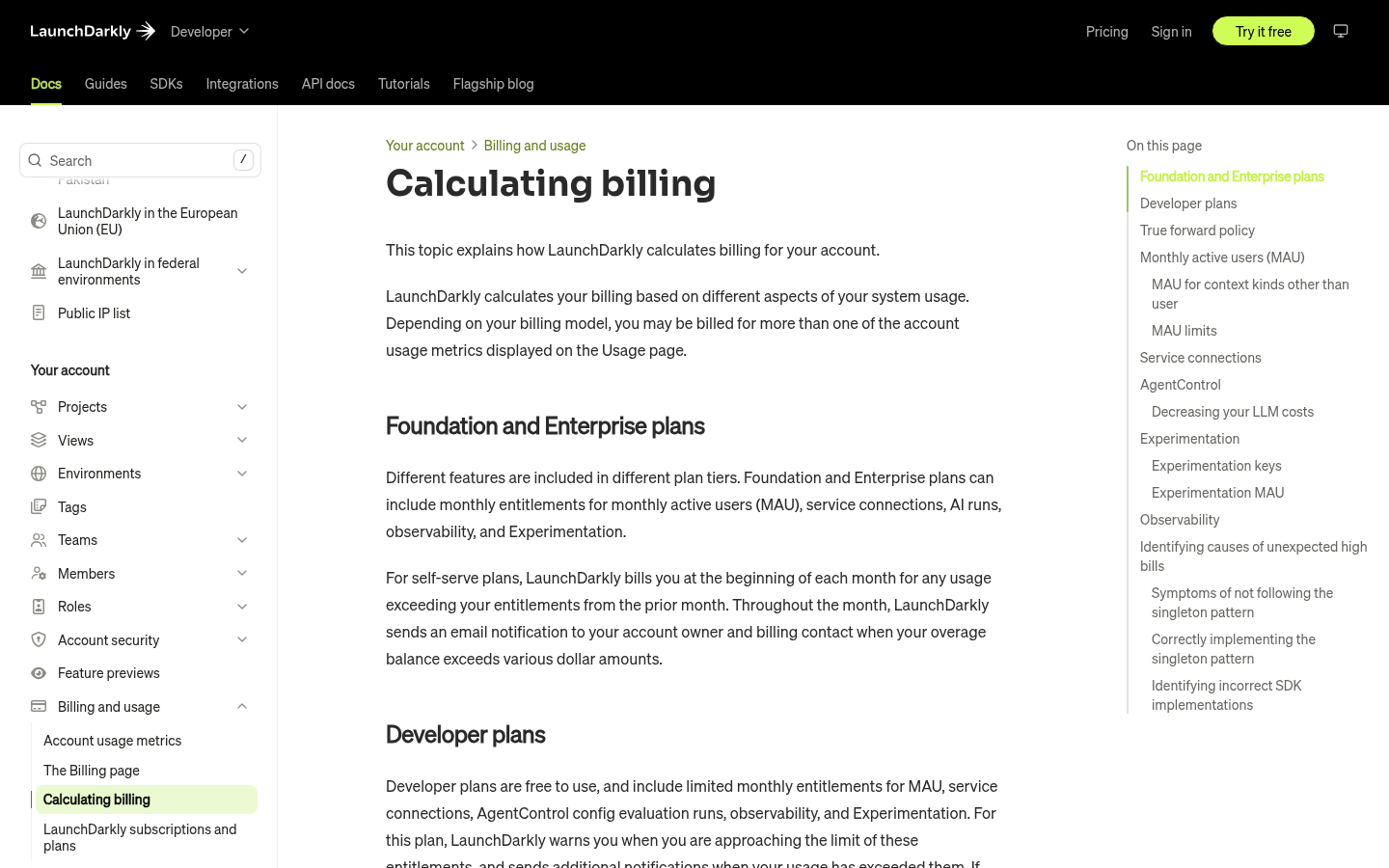
The 'Calculating billing' page defines MAU, service connections, AI runs and the true-forward policy. It also lists the SDK mistakes that inflate a bill: instantiating the client inside a request handler or a loop. Read it before you sign, because a wrong integration pattern changes your invoice.
- MAU counts unique context keys, and changing a key counts as a new user
- Online evals count as two AI runs
- Self-serve overages are billed at the start of the next month
Final verdict
LaunchDarkly pricing is the cost of a mature product with a usage meter that does not forgive sloppy architecture. If you run a handful of long-lived services, keep client MAU modest and need an audit trail, the Enterprise route is defensible and the flag tooling is among the best documented.
If your platform is mostly Kubernetes or serverless, you will not get a list price, and the first quote is where the real negotiation starts. Ask for the connection count in writing and ask whether Guardian is in scope.
The honest comparison is Statsig, ConfigCat, Flagsmith and Unleash, which meter differently and often cost less at scale. LaunchDarkly wins on depth and ecosystem. It loses on forecastability. Score: 7.6 out of 10.
- Flag capability 9/10 Unlimited flags, segments, experiments
- SDK coverage and latency 8.5/10 30 SDKs, SLO under 200 ms on Foundation
- Pricing predictability 5/10 Two meters, custom quotes for common stacks
- Release safety automation 6.5/10 Guardrails exist, but behind Guardian
- Governance on self-serve 6/10 Audit and approvals are Enterprise only
- Support on self-serve 6/10 Community Discord on Developer and Foundation
Common questions
How much does LaunchDarkly cost in 2026?
Is there a free LaunchDarkly plan?
What is a service connection?
How does LaunchDarkly count MAU?
Is LaunchDarkly worth the price?
Does LaunchDarkly include automatic rollback?
What are the cheapest alternatives to LaunchDarkly?
Update log
- Initial publication. Pricing page, plan table and billing docs captured on 5 October 2026; three bills modelled.